
Pro Inside Public Company Limited recognizes the importance of risk management as a crucial mechanism for good corporate governance and a foundation for supporting business operations to achieve strategic objectives efficiently, and to foster stable and sustainable long-term growth. Appropriate risk management enables the company to make prudent decisions, considering both opportunities and potential impacts arising from changes in the business
environment, technology, and relevant regulations. The company has established an Enterprise Risk Management (ERM) system, covering the processes of identifying, assessing, and managing risks, as well as continuous monitoring and reporting of risk status. This ensures that risks that may affect the company’s operations, performance, and reputation are managed appropriately, promptly, and in line with the organization’s acceptable risk appetite
Risk Management Standards and Guidelines
To ensure systematic risk management aligned with international best practices, the company has adopted the COSOEnterprise Risk Management Integrated Framework throughout the organization. This integrates risk management intobusiness planning, routine operations, and strategic decision-making processes, ensuring that business operations areconducted within appropriate risk levels and in accordance with good corporate governance principles.
The company mandates that executives and employees at all levels are responsible for identifying and assessing risks within their respective units, as well as establishing appropriate risk management measures. Risks that impact the achievement of the company’s objectives must be identified in a timely manner, with opportunities and impacts assessed, risks managed considering appropriate costs and benefits, and continuous monitoring of results. Risk management policy document
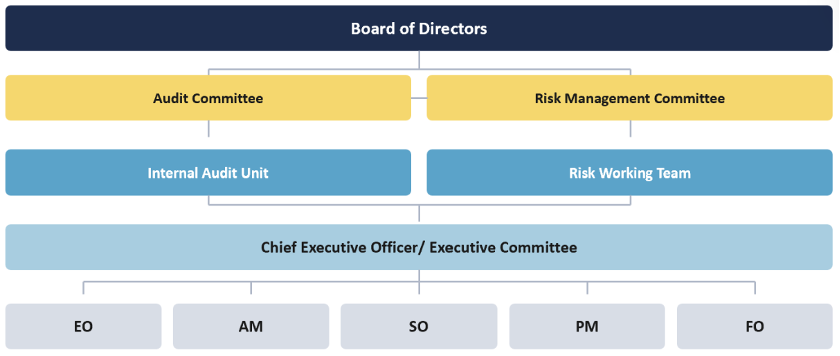
Board of Directors and Audit Committee
Responsible for overseeing that the company has an appropriate risk management system, with effective reporting and monitoring. It receives quarterly reports on risk status and risk management outcomes from the Risk Management Committee.
Risk Management Committee
Consists of 4 directors, with an independent director serving as chairman. Its duties include setting risk management policies and acceptable risk levels, proposing them to the Board of Directors for consideration, overseeing the development and implementation of the risk management framework, reviewing significant risk reports, and presenting
an overview of risks, including the adequacy of internal control systems, to the Board of Directors, while also providing recommendations to relevant departments.
Risk Management Working Group
Comprises representatives from the company’s key departments. Its duties include supporting the operations of the Risk Management Committee by coordinating, collecting, analyzing, and assessing risks at the departmental and organizational levels, preparing risk status reports, monitoring the implementation of risk management plans, and promoting knowledge and understanding of risk management among employees throughout the organization
Monitoring, Evaluation, and Continuous Improvement
The company promotes risk management as a shared responsibility among personnel at all levels, while supporting theuse of information technology for integrated risk management. The Risk Management Committee will independentlyand systematically evaluate performance at least once a year, both at individual and committee levels, and reportevaluation results, problems, obstacles, and improvement guidelines to the Board of Directors to continuously enhance the organization’s risk management efficiency